
Applied Learning | Field Engagement | SDG-Aligned | UGC Credit-Compatible
Environmental Education (EE) goes beyond textbooks as it nurtures understanding, responsibility, and action towards a sustainable future. It empowers individuals to recognise the interconnections between environmental challenges, economic development, and human well-being, and to actively contribute to solutions. Integrating EE into formal education systems is not only transformative but essential for inclusive and sustainable growth.
Higher Education Institutions (HEIs) play a vital role in building skilled, responsible citizens who contribute meaningfully to society. In alignment with the National Education Policy (NEP) 2020, institutions are encouraged to offer credit-based courses that promote community engagement, service learning, and environmental responsibility, thereby advancing the goals of SDG 4 (Quality Education).
As per the UGC 2023 Guidelines, EE is being strengthened as a core component of higher education through a 4-credit course model. The framework emphasises experiential learning, community engagement, and real-world applications alongside theoretical understanding, enabling students to earn credits over six to eight semesters.
About CEE
Established in 1984, the Centre for Environment Education (CEE) is a national institution committed to advancing Education for Sustainable Development (ESD). Recognised as a Centre of Excellence by the Ministry of Environment, Forest and Climate Change, Government of India, CEE works across the country through its regional offices and national programmes.
With over four decades of experience, CEE integrates environmental education into schools, higher education institutions, and community systems. Its work spans climate change, biodiversity conservation, water and sanitation, waste management, sustainable lifestyles, youth engagement, and community-based action. CEE ensures that environmental learning moves beyond awareness to measurable impact.
Youth Internship Programme @CEE
As part of its youth and higher education initiative, CEE has been offering internships and volunteering since 2005 through South Asia Youth Environment Network (SAYEN), on projects and activities related to sustainable development. The interns are placed with CEE Groups/ Offices in India and are involved in ongoing projects. The minimum period of internship is 21 working days, and the maximum is a year. Every year, CEE places 100+ interns at various offices in India, of whom 4-5 are international students.
Why This Programme?
In response to recent developments and requirements, CEE has developed a tailor-made internship programme that will be offered as a mentored, project-based learning journey designed for undergraduate, postgraduate, and early-career professionals. This programme bridges classroom knowledge with real-world sustainability practice.
It is aligned with:
It bridges classroom learning and real-world sustainability practice, ensuring internships are not ad hoc volunteering but structured academic engagements.
Internships are offered in a blended mode, including
UGC-Aligned Credit Structure (*1 Credit ≈ 30 hours (UGC reference)
|
Model |
Hours |
Credits* |
Recommended For |
|
Foundation Internship |
60 hrs |
2 Credits |
Entry-level UG |
|
Standard Internship |
120 hrs |
4 Credits |
Mandatory UGC Internship |
|
Advanced Internship |
180–240 hrs |
6–8 Credits |
Honours / Dissertation |
The internship includes an assigned mentor and regular weekly guidance to ensure structured learning and meaningful engagement. Participants will attend a skill-building workshop and be evaluated through a clearly defined assessment rubric. Upon successful completion, interns will receive a completion certificate, and outstanding performers will be awarded a merit-based performance letter. Select models also include access to an optional CEE Academy course to further strengthen their learning experience.
To support university credit mapping and academic recognition, CEE will provide a formal offer letter specifying the total hours of commitment, a structured Internship Agreement, clearly defined learning outcomes, and an attendance log sheet to document engagement hours. The programme also includes a detailed evaluation rubric, a final assessment report, and a credit-compatible completion certificate to facilitate seamless integration with university requirements.
|
Model |
Hours |
Fee Range |
|
2 Credit |
60 hrs |
₹4,000 + GST |
|
4 Credit (Flagship) |
120 hrs |
₹7,500–8,500 + GST |
|
6–8 Credit |
180–240 hrs |
₹9,000–12,000 + GST |
STEP 1 Application by students for internship @CEE
STEP 2 Scrutiny and Online Interview for selected batch of students
STEP 3 After getting selected as an intern, signing of a declaration form on Code of Conduct & Confidentiality Undertaking
STEP 4 Online orientation and assigning students to respective CEE team
STEP 5 Field Immersion, Project Work and Mentoring
STEP 6 Overall course evaluation, feedback and Certification with Performance letter for HEI
Thrust Area
Education For Children
Education For Youth
EE in Higher Education
Nature Camps
Interpretation of Natural & Cultural Heritage
Coastal And Marine Programmes
Climate Change
Environment Management
Sustainable Rural Development
Sustainable Urban Development
Water and Sanitation
Waste management
Disaster Preparedness and Rehabilitation
Facilitating NGO and Community Initiatives
Materials Development And Publications
Biodiversity Conservation
Communicating through Media
Research in EE and ESD
Event Management
Gallery


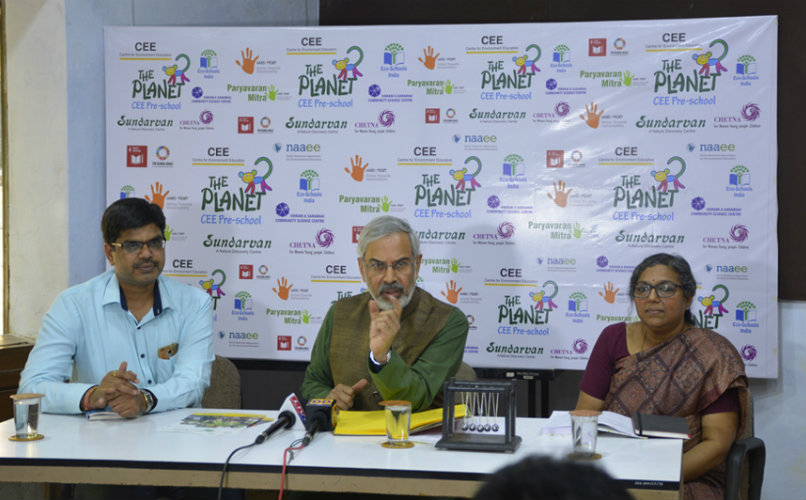
Established as a Centre of Excellence of the Ministry of Environment, Forest & Climate Change, Government of India.